Some govt, PNP officials to face IIRC probe on hostage crisis Friday
China's Ambassador Liu Jianchao met with Justice Secretary Leila de Lima on Thursday and discussed the Philippine government's investigation into the August 23 hostage tragedy that left eight Hong Kong tourists dead.
Liu said he and De Lima talked about the "mutual respect" between the two nations amid the global backlash against Philippine law enforcement authorities for their bungled hostage rescue operations.
De Lima chairs the Incident Investigation and Review Committee (IIRC), which is set to hold on Friday its clarificatory questioning for persons that had key roles in handling the hostage drama last week.
The committee's other members are: Interior Secretary Jesse Robredo as vice chair; Teresita Ang-See, chairperson of the Citizens Action Against Crime, representing the Filipino-Chinese community; Herman Basbaño, president of the Kapisanan ng mga Brodkaster ng Pilipinas, representing the media; and Roan Libarios, governor of the Integrated Bar of the Philippines Eastern Mindanao, representing legal luminaries.
The proceedings will also be held on Saturday and Monday next week.
On the other hand, The Philippine Embassy in Beijing has advised Filipinos there to keep a "low profile" as tension still exists between the Philippines and China over the August 23 hostage tragedy in Manila where eight Hong Kong tourists were killed.
The embassy said that any "untoward incidents" related to this should be reported to them through the hotline 13911180495.
During a Senate hearing Wednesday, Foreign Affairs Undersecretary for Migrant Workers Affairs Esteban Conejos said he hasn't received any report that Filipinos are being abused in Hong Kong or elsewhere in China because of last week’s hostage tragedy.
Jackie Chan, a native of Hong Kong, starred in several Hollywood films, including blockbuster “The Karate Kid”, tweeted about the Philippine Hostage Taking earlier today. In his Twitter account, Chan said he heard about “the terrible news” upon returning to Hong Kong from Korea.
“I come back to hk & I hear terrible news about what happened in filippines [sic]. A lot of things don’t happen to your own country you don’t pay attention,”
Chan noted the hostage taking could have happened elsewhere but it was heartbreaking that it had to happen to Hong Kong citizens.
“This kind of things always happen around the world [sic]. It happened to hk’s people, the whole hk is talking about it. It’s really sad,” Chan said.
Chan also felt and acknowledged that authorities were in a difficult position during the hostage crisis.
“If they killed the guy sooner, they will say why not negotiate first? If they negotiate first, they ask why not kill the guy sooner? So sad,” he said.
On Monday, Rolando Mendoza, a disgruntled ex-policeman took hostage a busload of Hong Kong tourists.
The day-long crisis ended after police killed Mendoza.
Despite reports of discrimination against Filipinos in Hong Kong, Chan also assured that his country won’t encourage hate.
“HK is a nation built by a lot of different people..don’t worry! We do not hate!” said Chan. “Humans should be united and not kill or hate each other.”
Chan has been active supporting humanitarian and charitable works. He had visited the Philippines August 2006 and met with representatives from the Philippine National Red Cross, UNAIDS, and World Wildlife Fund.
I recently came across this photo spread over the Internet which was shared just minutes ago by my friend in Plurk. You can see here these 'gentle' men smiling and posing right near the bus which was hi-jacked. But let me take you to the whole subject of this article. In an interview with the Philippine Inquirer, Interior Secretary Jesse Robredo admitted that mistakes had been made.
Philippine police have admitted they did not have the skills, equipment or training to handle Monday's bus siege, in which eight Hong Kong tourists were killed after being taken hostage. The force said talks with the gunman had been handled poorly, and relations with the media had broken down. Security experts, survivors and Chinese officials have all criticised the Philippine authorities.
They even had an article on their website that the Philippines didn’t need the deadliest attack on foreign tourists to expose the flaws in its security forces.
The Philippine National Police, once again, highlights a chronic systemic failure in its operations. Problems like shortage of vehicles, radios and fuel in a country prone to kidnappings, gun violence and attacks by insurgents. These problems were shown and even exposed worldwide on all forms of media last on Aug. 23 when an ex-officer took 25 people hostage on a tourist bus in Manila to protest his dismissal -- and eight members of a Hong Kong tour group died in the rescue attempt. One interview says that the assault team had "inadequate" skills and failed to control the crowd or media. The hostage drama came to an end when police marksmen killed the gunman. He was identified as 55-year-old Rolando Mendoza, a former policeman who had seized the bus in a desperate bid to get his job back.
Buddhist monks led prayers for the victims in Manila on Tuesday, while angry demonstrators converged on the Philippine embassy in Hong Kong. The Philippines has promised a thorough investigation and is sending a delegation to Hong Kong to explain what happened. Of 25 people initially taken hostage, nine were freed after initial negotiations. The UK Foreign Office said two of them were British nationals. The Philippine driver then fled the bus, leaving 15 people on board with the gunman until the end of the siege. Unconfirmed reports say at least one of the dead was a dual Chinese-Canadian citizen.
Bloomberg correspondent in Bangkok, Daniel Ten Kate, in his article said that the tourist deaths underscore the risks of traveling and working in a country ranked 130th out of 149 in the Global Peace Index, which weighs factors such as violent crimes, access to weapons and political instability. Seven foreign chambers of commerce representing companies such as Royal Dutch Shell Plc, Europe’s largest oil company, and Citigroup Inc., the third- biggest U.S. bank, asked the government in May to rescind an order to publish the names of top taxpayers on safety concerns. Tourism to the Philippines, an archipelago of more than 7,000 islands with Asia’s highest unemployment rate, has lagged behind the rest of the region. The nation attracted 3 million tourists last year, about a tenth the number that visited Malaysia, according to the Association of Southeast Asian Nations.
POLICE OPERATION DURING THE MANILA AUG.23 HOSTAGE CRISIS:
Changing the security environment will require an overhaul of the national police so officers have the right equipment and training, said Ian Bryson, a Singapore-based analyst for Southeast Asia and the Pacific at Control Risks. Herman Joseph Kraft, executive director of Manila's Institute for Strategic and Development Studies said that this is a systemic problem. The Manila police department is supposed to be the largest in the Philippines, the best trained and best equipped. But we saw how far below standard they fall.
“Bigger long-term issues are the ready availability of firearms, the culture of violence of criminal gangs and how it is fostered by family dynasties in politics,” he said. “It’s all connected: the guns, the violence, the money, the crime. A penny novella played every day.”
A tragic death and bloodshed ended the 12-hour hostage drama aboard a Philippine bus yesterday , with at least seven Chinese tourists dead along with the disgruntled ex-policeman who hijacked the vehicle and demanded his job back, officials said.
The killing of eight Hong Kong tourists taken hostage on a Manila bus has generated a huge outpouring of grief, frustration and anger in the Chinese territory.
Police storm a bus where a former policeman was holding a group of Hong Kong tourists, killing him but unable to save all of the hostages.
Mendoza was formerly with the Manila police's mobile patrol. Mendoza was a former recipient of the 1986 Ten Outstanding Policemen of the Philippines of the Jaycees International. It can be recalled that civil engineer Jun Ducat, a day-care center owner, held more than 30 youngsters and teachers hostage on a bus some time in 2007. The standoff, which Ducat used to denounce corruption and demand better lives for impoverished children, lasted about 10 hours.
The crisis began when the dismissed policeman, Rolando Mendoza, 55, armed with a M16 rifle seized the busload of Hong Kong tourists to demand his reinstatement in the force.
According to newspaper reports from 2008, he was among five officers who had been charged with 32 counts of illegal detention and abduction, illegal possession of explosives and illegal possession of firearms after a Manila hotel chef filed a complaint alleging the policemen falsely accused him of using drugs to extort money.
The Hostage Scene: Amid heavy rains, policemen on Monday night started assaulting the tourist bus where a dismissed police officer was holding hostage at least 17 Chinese nationals, a report on GMA News' "24 Oras" said.
Rapid fire was heard at around 8:18 p.m., the live report said. A civilian was hit by a stray bullet and was rushed to hospital.
The police immobilized the bus by shooting at its tires.
At least two teargas canisters were lobbed into the bus as policemen struggled to open the door.
Moments after shots were fired, the driver of the bus, who was earlier reported handcuffed to the steering wheel, escaped. The shots forced media men covering the hostage crisis to scamper for safety.
In the morning, police sharpshooters took positions around the white-blue-red bus. The road was sealed off as officers negotiated with the hostage-taker.
In the afternoon, Mendoza released two women, three children, a diabetic man and three Filipinos. While releasing some of his hostages, Mendoza demanded that his son be brought to Manila via an Air Force helicopter. But Philippine Air Force spokesman Lt. Col. Miguel Okol said, "There is no official request so far. We're monitoring the situation."
Mendoza wrote some of his demands on paper and posted it on the bus windows.
Before noon, he posted message about his demands: "Big mistake to correct a big wrong decision." "Big deal will start after 3 p.m. today." "Three p.m. today dead lock."
Later Mendoza asked hostage negotiators — Superintendent Orlando Yebra and Chief Inspector Romeo Salvador — to load up another gallon of gasoline into the air-conditioned bus. Earlier in the day, he asked that the bus be refueled. He sought for an interview with a broadcast journalist to help him negotiate with authorities for his demand to be reinstated to work.
The Tragic Death of Mendoza 8/23/2010
Six captives survived, four of whom were seen crawling out the back door of the bus after Philippine police stormed it Monday evening when the hostage-taker started shooting at the 15 Chinese tourists inside, said police Senior Superintendent Nelson Yabut.
He said the hostage-taker was killed with a sniper shot to the head after he wounded a police sharpshooter.
One other hostage was hospitalized in critical condition, and five others were unharmed. Officials have yet to disclose the fate of the remaining two hostages.
'Jersey Shore' star Ronnie arrested by Seaside Heights police, reportedly for unpaid parking tickets.
Ronald "Ronnie" Ortiz, 24, was taken into custody by police on Sunday for outstanding warrants, the New Jersey Star-Ledger reports.
Picked up at the Jersey Shore cast's house by cops in an unmarked squad car, Ortiz was arrested calmly and without handcuffs.
"On August 15, 2010, Ronald Ortiz was placed under arrest for outstanding warrants from two separate jurisdictions," the Seaside Heights PD confirmed in a statement to RadarOnline.com.
"Mr. Ortiz was transported to the Seaside Heights Police Department where he was processed and later released after satisfying the conditions of these warrants."
We think its important for all of us to understand what happened during the Maguindanao massacre so that it will strengthen our desire to not let this pass.
We are hoping that if we understand what happened, we will understand better why we must persist and demand justice for the victims from the Philippine Government.
“My wife’s private parts were slashed four times, after which they fired a bullet into it,” he added.”They speared both of her eyes, shot both her breasts, cut off her feet, fired into her mouth. I could not begin to describe the manner by which they treated her.” Esmael Mangudadatu Jr said.
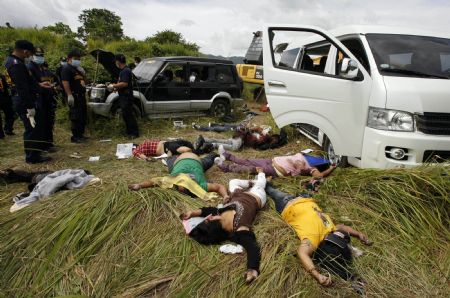
Five of the convoy’s blood-spattered and bullet-riddled vehicles were found on Monday alongside an unpaved farm road near many of the bodies, said Chief Superintendent Felicisimo Khu, the top police forensics official on the scene.
The final car was also found close by on Wednesday in a hastily dug grave alongside 11 freshly discovered bodies, Khu said.
But police also unearthed a sedan and a second van, neither of which was part of the convoy and which were owned by residents of the area who had no affiliation to the politicians or journalists, according to Khu.
“The car and the second van were not part of the convoy,” Khu said. “They just happened to drive past.”
more info:
The Maguindanao massacre is also known as the Ampatuan massacre (after the town where the mass graves were found) and this happened on the morning of November 23, 2009, in the Ampatuan town in the province of Maguindanao, Philippines. The said victims were about to file a certificate of candidacy for Esmael Mangudadatu, vice mayor of Buluan town. Mangudadatu was challenging Datu Unsay mayor Andal Ampatuan, Jr., the son of the incumbent Maguindanao governor Andal Ampatuan, Sr., in the forthcoming Maguindanao governatorial election, part of the national elections in 2010. The 57 people killed included Mangudadatu's wife, his two sisters, journalists, lawyers, aides, and motorists who were witnesses or were mistakenly identified as part of the convoy.
27 November 2009 – The head of the United Nations agency tasked with defending press freedom today urged the Government of the Philippines to investigate the 23 November attack on a convoy in the province of Minguindanao that left over 55 people, including at least 27 journalists, dead.
“This monstrous crime must not go unpunished,” said Irina Bokova, Director-General of the UN Educational, Scientific and Cultural Organization (UNESCO).
“I condemn this outrage and urge the Government of the Philippines to act swiftly, using all the resources at its disposal to bring the perpetrators to justice.
“The barbaric killings of the people in the convoy – journalists and citizens alike – were clearly an attack against democracy and democratic processes. Furthermore, the killing of journalists violates the rights of the Philippine people to be freely and fairly informed of political developments,” she added.
The journalists were reportedly travelling with politicians and political supporters to file nomination papers for a gubernatorial candidate in Maguindanao province in the southern Philippines, when the convoy was ambushed, UNESCO stated in a news release.
The agency said last week's deaths bring to 34 the number of journalists killed in the country this year.